Tag: military history

Book review – The Secrets of Anzac Ridge: In Flanders Fields, by Patricia Skehan

Title: The Secrets of Anzac Ridge: In Flanders Fields – an extraordinary account of life in and out of the trenches.

Author: Patricia Skehan

Publisher: Hachette Australia, 2025; RRP: $34.99

Reviewed by: Rhonda Cotsell, Ballarat Writers Inc. book review group

Despite what its title suggests, this work is centred on a small town called Steenwerck, located near the site of the Battle of Fromelles. Steenwerck was the base for the 2nd Australian Casualty Clearing Station, a military hospital which played a major role in receiving and treating casualties from  Fromelles and transporting them to the nearby railway for evacuation from the front. (Anzac Ridge was an important site in the Third Battle of Ypres, casualties from which would also have passed through the Steenwerck clearing station.) A feature of the area was the duckboards put down to make walkways over the muddy ground, an innovation my grandfather, who served as a soldier and stretcher bearer, would have been familiar with.

Patricia Skehan, author of The Secrets of Anzac Ridge: In Flanders Fields, was a founding executive member of the City of Canada Bay Heritage Society, who has toured Australia speaking and lecturing for organisations such as Probus and U3A, VIEW clubs and historical societies.

The story of The Secrets of Anzac Ridge: In Flanders Fields draws on a compilation of raw material extracted from Trove, the National Library of Australia (NLA) newspaper database, which contains digitised newspapers and newsletters. Other material is sourced from family-held letters, diaries, and the NLA catalogue. Much use is also made of  material from the diary of General Sir John Monash, and another held by the family of a young enlistee, James (Jim) Armitage.

The material has been organised into sections grouping specific themes, colourfully headed such as Shattered Humanity, Strong Language, Cobbers, Mademoiselle From Armentieres, and more. Because it’s not organised chronologically, it presents as a series of short and highly colourful,  always emotionally charged, snapshots of that very much larger and vastly more complex field. Hearing these voices rising out of this period of history is effective, but highlighting certain aspects while showing them out of that larger context, hence omitting much, and connected only by what the author chooses to say about them, risks skewing the reader’s awareness of the events.

Similarly, reviewers are susceptible to bias when they review a book. It’s hard to avoid sometimes. As this reviewer, I acknowledge my bias from growing up hearing WW1 stories my grandfather, Angus McSwain, told my father. Angus was a private in artillery, fought in the trenches and was also a stretcher bearer, first at Gallipoli and later the Somme.

Medical orderlies at the 2nd Australian Casualty Clearing Station near Steenwerck moving patients over duckboard walkways (to avoid the muddy ground) using a two-tiered stretcher holder on wheels. The stretcher holder could run along railway tracks leading to the train (seen in the background), which pulled up right at the camp. Here the orderlies are changing direction at a turntable. Source: AWM

My father told me about seeing the strange whiteness of his father’s feet, a result of trench foot Angus suffered for the rest of his life, and showed me the word neurasthenia on his discharge papers. He told me Angus’s story about walking on duckboards across mud at the head of a line of men, a bomb falling, and looking behind to discover he was the only one left standing. One day while out rabbiting together, he asked his father innocently as a curious boy whether he had killed any Germans, and his father just wept silently all the way home. The shame he suffered from hurting Angus lasted till he died. 

Consequently, there were areas of The Secrets of Anzac Ridge that left me cold. Almost voyeuristic, the book reads as trapped in an unpleasant and unnatural excitement, like a closed bubble in time where emotions are huge and the events filtered by the author’s presence. There is also at times a strong sense of the author wanting to present a cheerful light that felt both invasive and manipulating. There is much about the Australian Digger spirit, their ‘good cheer and revelry’ despite dreadful suffering, and many extracts which seem to have little to do with what the title offered.

One extract the author chose to include really threw me. It is the author’s choice of material to give a picture of British Field Marshal Douglas Haig compared to that of Australian Brigadier General Harold ‘Pompey’ Elliott in relation to Fromelles and the Battle of the Somme. Haig responsible for the needless death of thousands, and Australians specifically, and the other, also aware, who had to send his men into it. Angus among them.

General Haig … what struck me more than anything when he came into the room was his firm, healthy appearance and his keen, but sympathetic, eyes. His skin was clear, and he looked what he was, a clean-living man of action … (p158)

This is followed by more of the same. No mention of the horrendous death toll and inevitability of defeat that his ‘action’ would result in, nor the fact that opinions about Haig are still disputed today.

There is little re Elliott, the strict disciplinarian devoted to his men first and foremost, who, when the order was made, as a professional soldier and leader of the Australian 5th Division, was forced to obey despite his fears.

 In Trove, I found mentions of Pompey’s role everywhere, for example, an article in a 2006 issue of Army about an exhibition at the Australian War Memorial cites curator Peter Burness:

The 5th Division, the most recently arrived and the least prepared for battle … was put into the front line at Fromelles, resulting in 5500 casualties overnight and no ground gained at all,” Mr Burness said.

“Brig ‘Pompey’ Elliot [sic], one of the great fighting generals in the Australian Army, saw his brigade destroyed in front of his eyes,” Mr Burness said. “He greeted the survivors coming back off the battlefield with tears running down his face.”

Skehan’s only reference to the Australian leader is roughly three sentences, referring briefly to his popularity with his men, nothing about his role, and a brief comment re his postwar suicide, suggesting it due to an unnamed financial matter involving letting people down.

I located this unnamed financial matter in Trove – bad investments adding to his depression over feeling he had failed to provide for his family properly – along with an inquest report and an item quoting the sister-in-law and attending doctors referring to deep depression caused by wartime suffering, shell shock and the suffering of the men under his command, plus copious records referring to the sort of man he was and his role in Fromelles, and his ongoing work postwar protecting the rights of those men who made their way home.

Central Highlands readers may also find it interesting that Pompey Elliott was from the Victorian Wimmera town of West Charlton, attended Ballarat Grammar and began law studies at university before leaving to fight in the Boer War.

However, though playing a massive role in the Gallipoli landing, in this work he is as good as invisible, while Haig glows, and this is what the reader will be left with.

Easy to read and entertaining as it is, I therefore would strongly recommend readers make sure to follow up with other reading on the same topic.

Review copy provided by the publisher.

If anything in this article has disturbed you, please know that Lifeline is available 24/7 on 13 11 14 (https://www.lifeline.org.au/), as is Open Arms, assisting those in the armed services, veterans, and their families – 1800 011 046 (https://www.openarms.gov.au/)

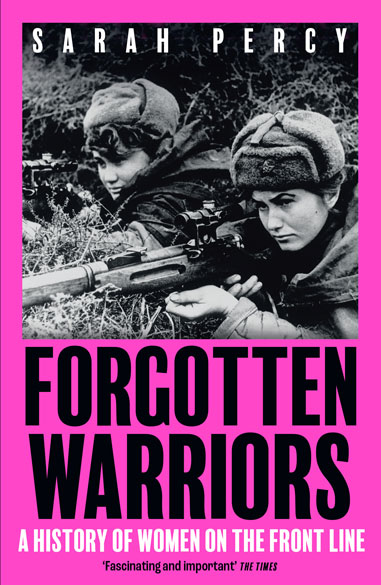
Book review: Forgotten Warriors, by Sarah Percy

Title: Forgotten Warriors: A History of Women on the Front Line

Author: Sarah Percy

Publisher: Hachette/John Murray, 2023; RRP $34.99
Dr Sarah Percy is an associate professor at the University of Queensland and former Fellow of Merton College, Oxford. She was also author and presenter of ABC radio series Why the Cold War Still Matters, and has written Mercenaries, another unconventional military history spanning multiple locations from medieval times to the present.

Forgotten Warriors is approached in the same way. What struck me about this work is how effectively the author tied together all the different strands across nations and recorded history to create a complex, cohesive picture of war itself and women’s roles in it. It is unstintingly relentless in its portrayal of what women can, and have done, destroying any notion that women don’t fight so comprehensively it was tempting  just to quote nothing but examples from this work. But a review needs more than just a list.  

The central theme of Forgotten Warriors, however, is not whether they were involved, but how women’s involvement in battle has been consistently and systematically concealed or misrepresented by military leaders since early recorded history. The book beginning with the example of the skeleton of a high-ranking Viking warrior surrounded by weapons and a horse being automatically identified as male for over a century until developments in DNA analysis revealed it, to widespread disbelief, to be female.

 In her research for Forgotten Warriors Dr Percy uncovers how large a role women have always played in conflict. Records show that female camp followers in European wars between the 15th to the 18th centuries, popularly described in history as wives and prostitutes, played essential support roles including feeding the armies, laundry and medical services, and fighting on the front line itself. Before them were Boadicea and Joan of Arc, and the millions of women who fought and died unnamed. Today women are fighting on the front lines in the Ukraine and Gaza, military and non military, on both sides and everywhere else a war is being fought.

The author identified a number of repeated reasons given for the belief that women do not belong in war. Among these were that it would destroy the bond of brotherhood between soldiers, that  women cannot fight, that their presence would distract male soldiers, that on the home front they would be taking men’s jobs, and finally that to acknowledge women as active participants in war was to damage the ‘feminine mystique’ necessary for peace time – at home and in the kitchen.

Watch Sarah Percy lecture on Forgotten Warriors

SAHR Lectures

What her research uncovers, however, is there are far more reasons why women are likely to be involved in war than not, that there is no real basis for the notion that women would sit passively aside while male family members, friends and neighbours went off to fight, or war came through their own front doors.

These discoveries are confirmed by what she details in Forgotten Warriors from when wars were first recorded. Some women, concealing their gender, were involved not for the above reasons but because soldiering was their chosen profession. The author also suggests homosexual or transgender women may also have found military life a safer option than civilian life. More telling is the fact that women were often conscripted, by military leadership bodies discovering repeatedly that wars could not be won without them.

There are countless stories of courage and of brutality, too many too repeat here. Some of the more dramatic include the hugely successful Russian Night Witches flying 24,000 missions using substandard bombers compared to their male counterparts, the terrifying Dahomey, and the Battalion of Death led by Maria Bochkareva. Google them.

Forgotten Warriors is not an easy read. I found it disturbing to find within it, for example, many instances where determination by military leaders to downgrade the input of women often involved putting them in dangerous situations, e.g., the  British women in WW2 who manned the huge anti-aircraft battery lights that spotlit attacking German planes. When enemy planes were caught in their sights the women became defenceless targets themselves, because women were not allowed to fire artillery while the men who did the same job could.

A confused sense emerges from history in Forgotten Warriors as it uncovers both military leaders and sometimes the men women fought beside, simply not being able to come to terms with the idea of women in wartime except in terms of needing to be protected, or inevitable victims of collateral damage. Being unable to openly acknowledge the need by women to fight for their own reasons, or essential contribution woman made when they were involved, leaves a gap it seems to have been too hard to traverse. 

During WW2 a high-ranking Russian official, Mikhail Kalinan, despite acknowledging that women’s involvement had strengthened the army and improved the behaviour of men, warned the women under his command that, post war,

Do not give yourself airs in your future practical work. Do not speak about the services you have rendered, let others do it for you. That will be better.

Betty Friedman, in her ground-breaking work The Feminine Mystique, would have loved ‘your future practical work’.

I want to stress, however, that the tone of Forgotten Warriors is one of serious military history and not a diatribe against men. Much of it is heartwarming, showing simple camaraderie between individuals fighting and suffering side by side. There are truly amazing, deeply human stories in there, celebrating both men and women at their best and worst in awful situations.

Target audience?

All those interested in military history and especially all those who believe women do not ‘belong’ in wars so they can test their understanding against what lies hidden beneath the other stories we have been told. 

Reviewed by: Rhonda Cotsell, March 2024

Ballarat Writers Inc. Book Review Group

Review copy supplied by the publisher

© 2026 Ballarat Writers

Theme by Anders NorenUp ↑